

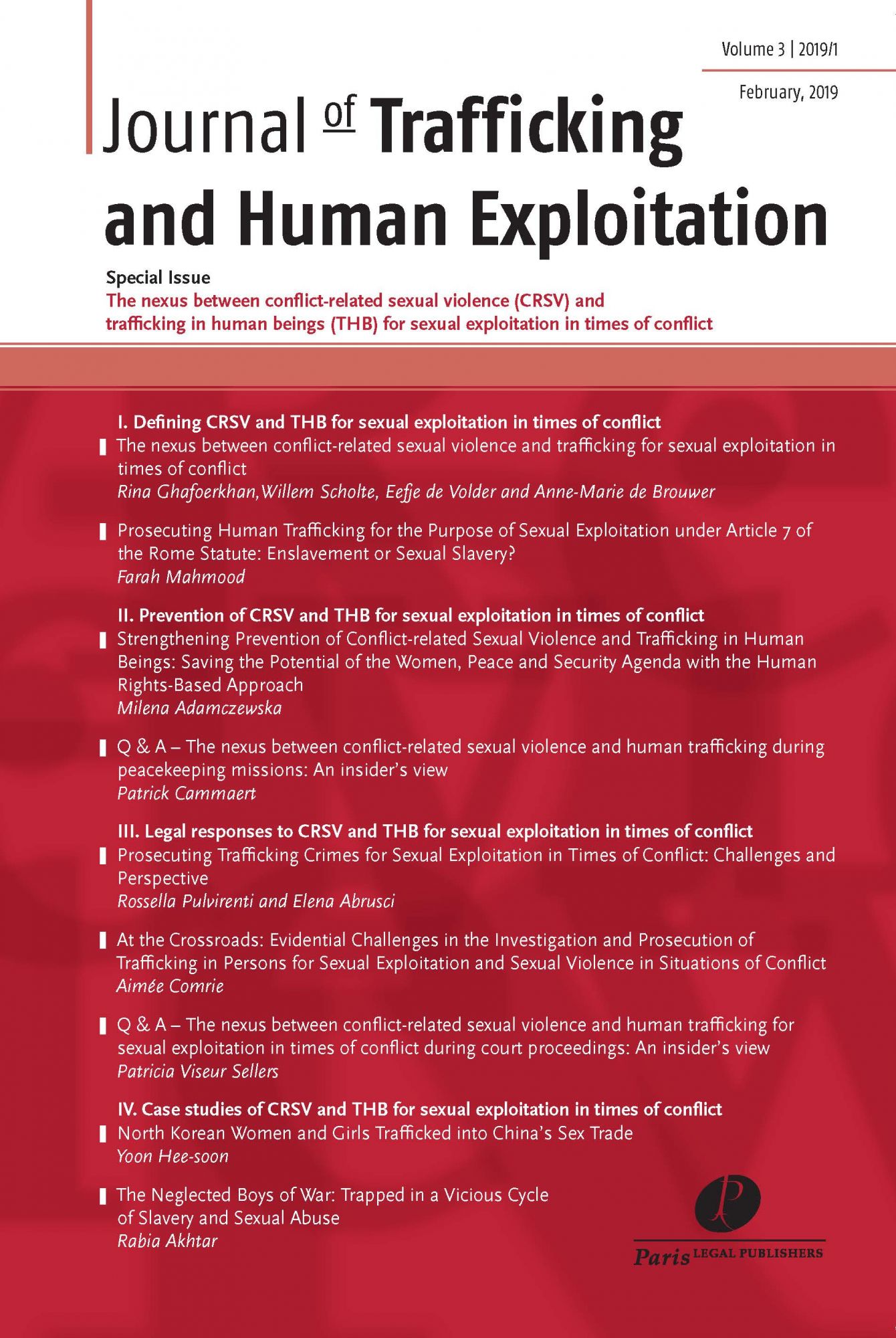
Forces of globalisation enable an ever increasing market for the commodification of human beings. In an effort to combat such actions, domestic, regional and international legal systems have outlawed trafficking in persons and various forms of human exploitation. Freedom from trafficking and such practices including slavery, servitude and forced or compulsory labour have also been codified in every human rights instrument across the globe establishing national obligations to investigate alleged abuses and prosecute offenders. And while there is a plethora of scholarship claiming various inadequacies pertaining to these laws and their use in practice, an academic and practical outlet focused on the laws of trafficking and human exploitation has yet to manifest.
The Journal of Trafficking and Human Exploitation (JHTE) will aim to fill this gap and serve as the premier forum to discuss and debate the legal and policy issues involving prevention, intervention, investigations, prosecution, individual, state and corporate responsibility, and the actual codified offenses, their application in practice, subsequent judicial interpretation and any ramifications emanating therefrom. As the mass perpetration of trafficking and human exploitation only appears to continue, the need to research, understand and clarify these laws and their use in practice is paramount.
This journal seeks high quality submissions reflecting a diverse range of perspectives addressing domestic, regional, international and comparative legal issues. The core submissions are intended from the following legal realms:
- Criminal law
- Human rights law
- International law
- Labour law
- Migration and asylum law
Addressing the substantive laws and jurisprudence involving human exploitation is an underexplored realm in need of attention and analysis. These include, but are not limited to:
- Slavery
- Servitude
- Forced and compulsory labour
- Sexual exploitation
- Recruitment and use of child soldiers
- Forced and early marriage
- Organ trafficking
The JTHE is primarily concerned with publishing high quality legal articles and significant case notes from domestic, regional and international jurisdictions. However, this journal will also consider interdisciplinary submissions and book reviews.
Peer review
The JTHE uses a double-blind peer review process.
Frequency
Two issues a year.
Prices and subscribe
1-Year subscriptions
Our prices are VAT Inclusive.
Executive Editor and Creator
Nicole Siller
Lecturer, Deakin University School of Law, Australia
Editorial Board
Jean Allain
Professor of Law
Faculty of Law, Monash University, Australia
Extraordinary Professor
Centre for Human Rights, Faculty of Law, University of Pretoria, South Afric
Michelle Madden Dempsey
Associate Dean of Faculty Research and Development
Professor of Law
Villanova University School of Law, USA
Luuk Esser
Researcher
Dutch Rapporteur on Trafficking in Human Beings and Sexual Violence against Children, also affiliated as an external PhD Candidate with Leiden Law School, The Netherlands
Kai Lindenberg
Professor of Criminal Law and Criminal Procedure
University of Groningen, The Netherlands
Jenny S. Martinez
Associate Dean for Curriculum
Professor of Law
Christopher Professor in the Practice of International Law and Diplomacy
Stanford Law School, USA
Mohamed Y. Mattar
Executive Director, The Protection Project
Clinical Professor of Law
Qatar University College of Law, Qatar
Megan K. Mattimoe
Executive Director
Advocating Opportunity, USA
Tomoya Obokata
Professor of International Law and Human Rights
Keele University School of Law, The United Kingdom
Ryszard Piotrowicz
Professor of Law
Aberystwyth University, The United Kingdom
Julia Planitzer
Scientific Associate
Ludwig Boltzmann Institute of Human Rights, Austria
Shea Rhodes
Director, The Villanova Law Institute to Address Commercial Sexual Exploitation
Villanova University School of Law, USA
Conny Rijken
Professor of Human Trafficking and Globalization
Tilburg University, The Netherlands
Gert Vermeulen
Director, Institute for International Research on Criminal Policy
Professor of Law
Ghent University, Belgium
Max Waltman
Visiting Research Fellow
Harvard University, Weatherhead Center for International Affairs, USA
Gus Waschefort
Senior Lecturer
Authors’s guidelines
Editorial policy
The Journal of Trafficking and Human Exploitation (JTHE) is primarily concerned with addressing legal issues involving the trade in human beings and their exploitation. As such, it will publish academic articles and essays which discuss and debate the legal and policy issues involving prevention, intervention, investigations, prosecution, individual, state and corporate responsibility, and the actual codified offenses, their application in practice, subsequent judicial interpretation and any ramifications emanating therefrom. Additionally, the JTHE will also publish significant case notes and relevant book reviews.
Publications Ethics
The JTHE editors will operate in alignment with the Code of Conduct for Journal Editors developed by COPE (the Committee on Publication Ethics), which provides a forum for publishers and Editors of scientific journals to discuss issues relating to the integrity of the work submitted to or published in their journals.
Potential conflict of interest
Conflict of interest exists when an author (or the author’s institution), reviewer, or editor has financial or personal relationships that inappropriately influence (bias) his or her actions (such relationships are also known as dual commitments, competing interests, or competing loyalties).
Editors who make final decisions about manuscripts must have no personal, professional, or financial involvement in any of the issues they might judge.
All participants in the peer-review and publication process must disclose all relationships that could be viewed as potential conflicts of interest.
When authors submit a manuscript, whether an article or another publication, they are responsible for disclosing all financial and personal relationships that might bias their work.
JTHE Peer review process
The JTHE peer reviews all the material it receives, internally and externally.
In order to ensure that the review process can be as efficient as possible for both authors and reviewers, all manuscripts are initially reviewed internally and then a decision is made about whether to send the paper for external review. The manuscript may be accepted, considered acceptable with revisions, or rejected.
The reviewers are specifically queried on the scientific originality, quality and correctness.
Manuscripts will be reviewed with due respect for the authors’ confidentiality.
Criteria for acceptance:
Importance and interest to this journal's readership
Scientific soundness
Originality
Degree to which conclusions are supported
Organization and clarity
Cohesiveness of argument
Length relative to information content
Conciseness and writing style
Appropriateness for the targeted journal and specific section of the journal
Content
Editorial
Articles and Essays
Articles and Essays will include theoretical and/or practical discussions on the codified offenses of trafficking and human exploitation, their application and interpretation. These submissions are particularly welcome in the journal and will provide a back-drop for future academic commentary and research.
Word count: 8000 words; refs included
References: 30+
Case notes
Cases can radically reform large areas of the law and affect legal practice in other arenas. A regular opportunity for case commentaries will ensure that the journal is at the forefront of significant legal developments.
Word count: 3500 words; refs included
References: 15+
Book/manual/legislative guide reviews
Word count: 2500 words; refs included
References: 15+
Submission of Contributions
Contributions should be submitted by e-mail, in Word to the Chief-Editor. Contributions will be considered for publication by the editors on the understanding that the articles have not previously been published and are not under consideration elsewhere.
The length of the articles should usually be no longer then mentioned above.
The title page should have the following information:
1. Article title.
2. Author(s) names and institutional affiliations.
3. The name of the department(s) and institution(s) to which the work should be attributed.
4. Contact information for corresponding authors.
5. Source(s) of support in the form of grants, equipment, drugs, or all of these.
6. Word counts.
7. The number of figures and tables.
Conflict-of-Interest Notification Page
When authors submit a manuscript, whether an article or another publication, they are responsible for disclosing all financial and personal relationships that might bias their work. To prevent potential conflicts of interest from being overlooked or misplaced, this information needs to be part of the manuscript.
An author maybe asked to complete a Conflict of Interest Disclosure Form.
An abstract of not more than 250 words should be submitted with the article.
Authors will be asked to submit at least three key words with their article.
For more details instructions see the ‘Editing instructions’
For information on copyright ownership see 'Rights and permissions'